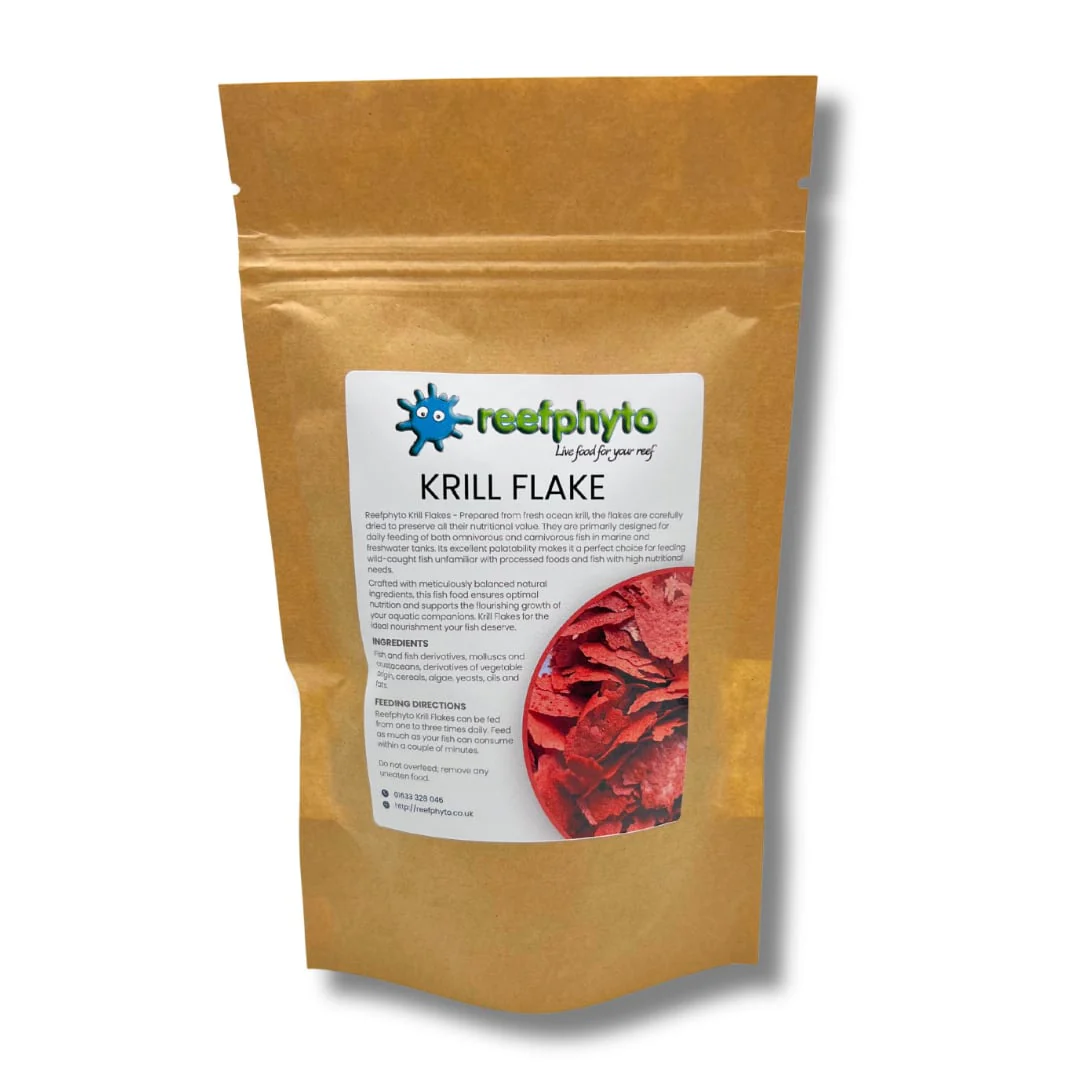
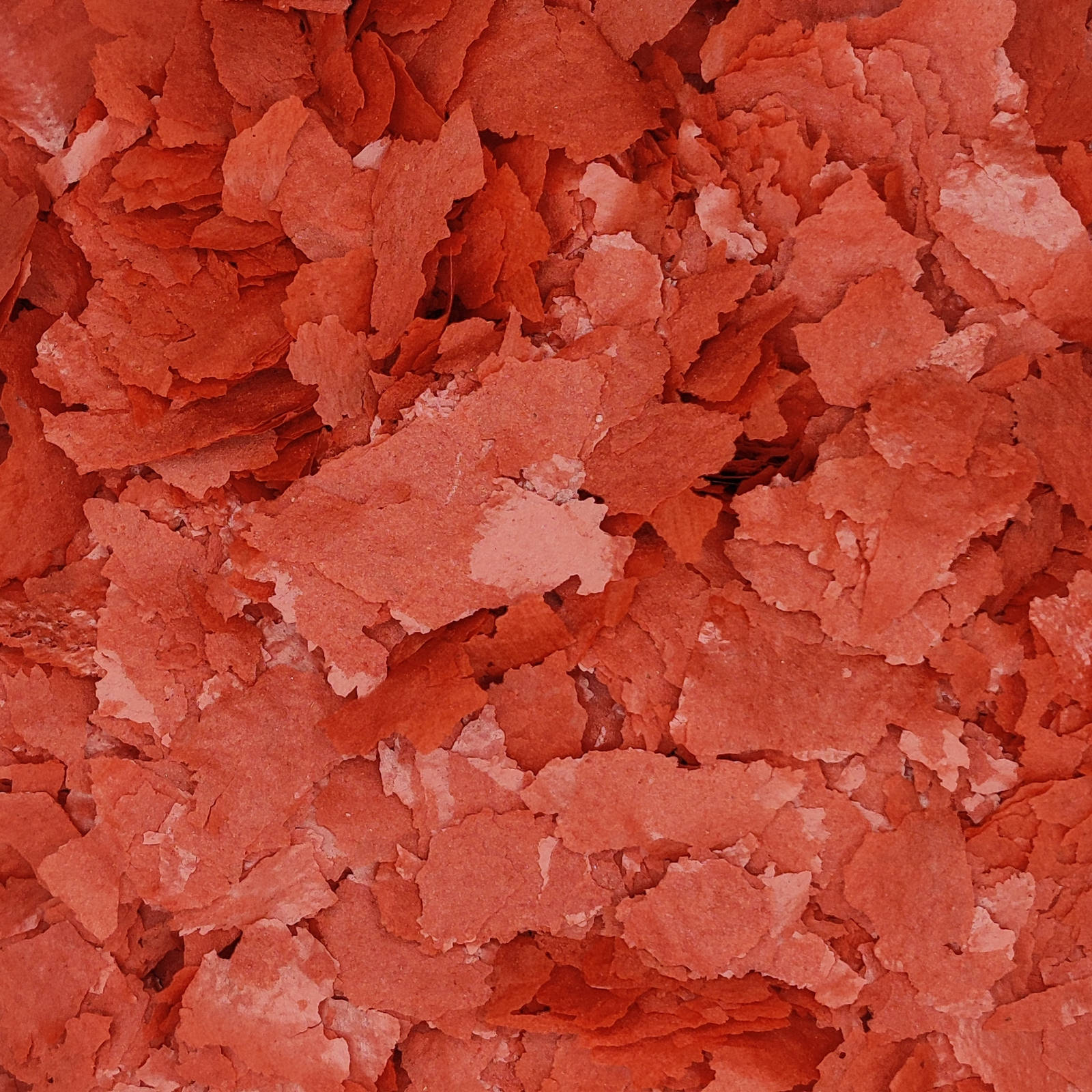
Reefphyto Krill Flake 45g
Reefphyto Krill Flake 45g - 40% Krill Meal Daily Flake for Marine and Tropical Fish
When marine fish decline on an apparently adequate diet, the cause is often not a lack of protein in absolute terms but a lack of the right protein in the right form. Krill occupies a specific nutritional position in the open ocean: it is the crustacean prey that lies between the tiny copepods and zooplankton at the bottom of the food web and the larger invertebrates and fish higher up. Many open-water marine species feed on krill continuously, and the carotenoid pigments they accumulate from it are the direct biochemical source of the red, orange, and pink colouration that captive fish often struggle to maintain.
A fish kept on a generic marine flake with no krill component is being denied one of the most naturally available nutrients in its wild diet. The colour fades gradually. The feeding response flattens. The fish looks fed, but it does not look right.
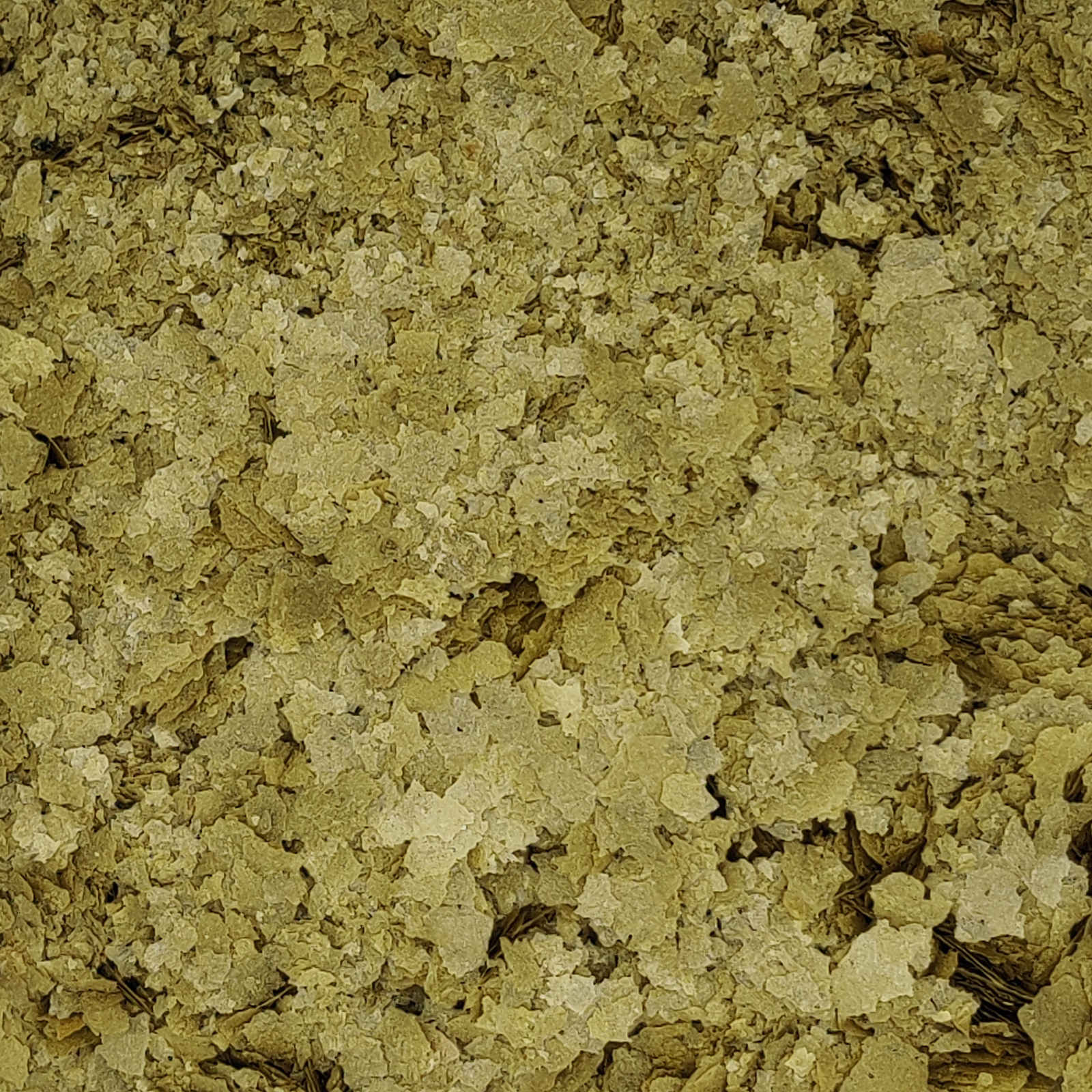
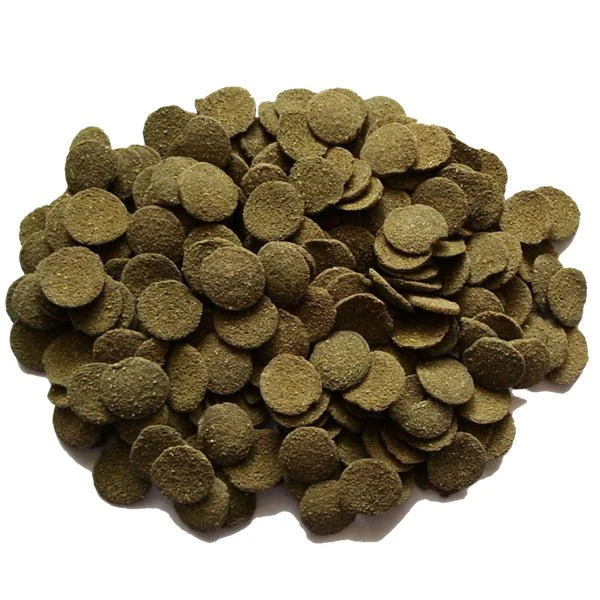
Reefphyto Krill Flake is a 45g daily flake food for carnivorous and omnivorous marine and tropical fish, with krill meal constituting at least 40% of the mollusc and crustacean fraction. Composition is molluscs and crustaceans (minimum 40% krill meal), fish and fish derivatives, cereals, vegetable protein extracts, algae, yeasts, oils and fats, and minerals including 1% zeolite for digestive support. Crude protein is 45.5%, fat 5.5%, with astaxanthin as a natural colourant sourced directly from the krill fraction, and lecithin for improved fat absorption. Feed one to three times daily, offering only what your fish will consume within two minutes.
The difference a krill-rich diet makes to a marine carnivore's colour is not subtle over time. Astaxanthin is the pigment responsible for the red and orange tones in wrasses, anthias, and many reef fish. It cannot be synthesised by the fish and must come from diet. A regular krill flake inclusion in the feeding rotation is the simplest way to ensure that source is consistently present.
Reefphyto sources, packs, and labels this flake ourselves from a trusted European supplier. For advice on building a complete feeding programme around live foods and dry foods for your specific fish, Darren is available at care@reefphyto.co.uk or on 01267 611533.
Feed your reef fish the crustacean protein they were built to thrive on.
Krill is not simply another crustacean ingredient on a fish food label. In the open ocean, Antarctic krill and related euphausiid species form some of the densest and most nutritionally significant prey masses on the planet. The fatty acid profile of krill is exceptionally high in omega-3, particularly EPA and DHA, in proportions that are difficult to match from any other single ingredient. The carotenoid content, predominantly astaxanthin, is the biochemical source of the red, orange, and pink pigmentation in a huge range of marine fish species. And chitin, the structural carbohydrate that forms the krill exoskeleton, acts as a natural prebiotic that supports gut health and immune function in ways that fish meal protein alone cannot replicate.
Marine fish that feed on krill in the wild accumulate these compounds continuously. In captivity, most standard flake foods deliver only trace amounts of krill-derived nutrition, if any. The consequence is gradual but consistent: colour that fades toward adequacy rather than vibrancy, fish that lose the richness of their natural pigmentation over months without obvious cause.
Reefphyto Krill Flake is formulated to deliver krill as a genuine nutritional centrepiece rather than a token ingredient.
Minimum 40% Krill Meal in Every Batch
The key specification that separates Krill Flake from other flakes in the Reefphyto range is the guaranteed minimum krill meal content. Krill meal constitutes at least 40% of the mollusc and crustacean fraction of this flake, which means every batch is formulated to a defined krill standard rather than a variable market-rate inclusion.
The full composition is molluscs and crustaceans (minimum 40% krill meal), fish and fish derivatives, cereals, vegetable protein extracts, algae, yeasts, oils and fats, and minerals including 1% zeolite. Analytical profile is 45.5% crude protein, 5.5% fat, 2.5% fibre, and 6.5% ash. Lecithin is included to support fat absorption and membrane integrity, and astaxanthin is present as a natural colourant sourced from the krill fraction itself.
Astaxanthin and Natural Colour Enhancement
Astaxanthin is the carotenoid pigment responsible for the red, orange, and pink tones in a wide range of marine fish, including anthias, wrasses, clownfish, and many reef community species. It cannot be synthesised by fish internally and must be supplied through diet. In the wild, it enters the food chain through crustaceans and algae. In captivity, it needs to come from food.
Generic marine flakes often list astaxanthin as a synthetic additive at low concentrations. In Reefphyto Krill Flake, the astaxanthin comes naturally from the krill meal fraction itself, alongside the full lipid and amino acid profile that accompanies it in its natural form. A fish fed a krill-rich diet over weeks begins to show it in the depth and saturation of its natural colouration in a way that synthetic additives rarely replicate with the same effect.
Zeolite for Digestive Support
One of the less commonly discussed ingredients in this formulation is the 1% zeolite inclusion. Zeolite is a natural mineral with a microporous structure that supports digestive function by binding ammonia and other metabolic waste products in the gut before they can be absorbed. In practical terms this means better nutrient absorption, reduced ammonia output into the water column, and a mild detoxification effect that supports liver health in fish fed high-protein diets regularly.
For carnivorous reef fish fed a protein-rich diet multiple times per day, the zeolite inclusion is a meaningful formulation detail that distinguishes this food from standard krill flakes on the market.
A Daily Food, Not a Supplement
Unlike Reefphyto Brine Shrimp Flake and Squid Flake, which are twice-weekly supplement foods to be used alongside a complete staple, Krill Flake is formulated as a daily food that can be fed one to three times per day as a primary diet component. The full vitamin pack, comprehensive trace element inclusion, and balanced macro profile make it suitable for everyday feeding without requiring a separate complete staple alongside it.
For the most nutritionally complete approach, rotating Krill Flake as a daily food with periodic live copepod additions from Reefphyto gives carnivorous and omnivorous reef fish both the krill-derived carotenoids and fatty acids from the flake and the live hunting stimulus and complex zooplankton nutrition from the copepods. The two approaches address different but complementary nutritional needs.
Which Fish Is This For?
Reefphyto Krill Flake is suited to carnivorous and omnivorous marine and tropical fish. In a reef context it is particularly well suited to anthias, wrasses, dottybacks, basslets, clownfish, chromis, damsels, hawkfish, and any species where natural carotenoid colouration is an important part of the fish's visual appeal. It is also a strong choice for wild-caught fish being conditioned onto prepared foods, as the scent and palatability of krill is one of the most broadly accepted feeding triggers across marine species.
It is also suitable for carnivorous freshwater fish, though the marine herbivore species in a reef community such as tangs and rabbitfish should continue to receive a vegetable-forward food such as Reefphyto Vegetable Flake as their primary diet.
Feeding Guide
Feed one to three times daily. Offer only as much as your fish will consume within two minutes per feeding. Store in a cool, dry location away from direct light and close the container after each use to preserve the integrity of the astaxanthin and fatty acid content.
Frequently Asked Questions
Is this a complete food or a supplement? It is suitable for use as a daily food. Unlike the Brine Shrimp and Squid flakes in the Reefphyto range, which are twice-weekly supplements, Krill Flake can be fed daily as a primary diet.
How does this differ from Brine Shrimp Flake and Squid Flake? All three are krill or crustacean-based high-protein flakes, but they serve different roles. Krill Flake is the daily carnivore food with the highest krill content, natural astaxanthin, and zeolite support. Brine Shrimp Flake and Squid Flake are twice-weekly supplement foods that add variety to any staple diet. For a well-rounded reef fish feeding programme, rotating all three across the week delivers broad nutritional coverage.
Will krill flake improve my fish's colour? For fish where natural astaxanthin-derived pigmentation contributes to colouration, a consistent krill-rich diet supports and maintains that pigmentation over time. Results vary by species and individual, but the carotenoid contribution from regular krill feeding is well established in aquaculture nutrition.
Is it reef-safe? Yes. Feed normally and remove uneaten food promptly to protect water quality.
Original: $9.28
-70%$9.28
$2.78Product Information
Product Information
Shipping & Returns
Shipping & Returns
Description
Reefphyto Krill Flake 45g - 40% Krill Meal Daily Flake for Marine and Tropical Fish
When marine fish decline on an apparently adequate diet, the cause is often not a lack of protein in absolute terms but a lack of the right protein in the right form. Krill occupies a specific nutritional position in the open ocean: it is the crustacean prey that lies between the tiny copepods and zooplankton at the bottom of the food web and the larger invertebrates and fish higher up. Many open-water marine species feed on krill continuously, and the carotenoid pigments they accumulate from it are the direct biochemical source of the red, orange, and pink colouration that captive fish often struggle to maintain.
A fish kept on a generic marine flake with no krill component is being denied one of the most naturally available nutrients in its wild diet. The colour fades gradually. The feeding response flattens. The fish looks fed, but it does not look right.
Reefphyto Krill Flake is a 45g daily flake food for carnivorous and omnivorous marine and tropical fish, with krill meal constituting at least 40% of the mollusc and crustacean fraction. Composition is molluscs and crustaceans (minimum 40% krill meal), fish and fish derivatives, cereals, vegetable protein extracts, algae, yeasts, oils and fats, and minerals including 1% zeolite for digestive support. Crude protein is 45.5%, fat 5.5%, with astaxanthin as a natural colourant sourced directly from the krill fraction, and lecithin for improved fat absorption. Feed one to three times daily, offering only what your fish will consume within two minutes.
The difference a krill-rich diet makes to a marine carnivore's colour is not subtle over time. Astaxanthin is the pigment responsible for the red and orange tones in wrasses, anthias, and many reef fish. It cannot be synthesised by the fish and must come from diet. A regular krill flake inclusion in the feeding rotation is the simplest way to ensure that source is consistently present.
Reefphyto sources, packs, and labels this flake ourselves from a trusted European supplier. For advice on building a complete feeding programme around live foods and dry foods for your specific fish, Darren is available at care@reefphyto.co.uk or on 01267 611533.
Feed your reef fish the crustacean protein they were built to thrive on.
Krill is not simply another crustacean ingredient on a fish food label. In the open ocean, Antarctic krill and related euphausiid species form some of the densest and most nutritionally significant prey masses on the planet. The fatty acid profile of krill is exceptionally high in omega-3, particularly EPA and DHA, in proportions that are difficult to match from any other single ingredient. The carotenoid content, predominantly astaxanthin, is the biochemical source of the red, orange, and pink pigmentation in a huge range of marine fish species. And chitin, the structural carbohydrate that forms the krill exoskeleton, acts as a natural prebiotic that supports gut health and immune function in ways that fish meal protein alone cannot replicate.
Marine fish that feed on krill in the wild accumulate these compounds continuously. In captivity, most standard flake foods deliver only trace amounts of krill-derived nutrition, if any. The consequence is gradual but consistent: colour that fades toward adequacy rather than vibrancy, fish that lose the richness of their natural pigmentation over months without obvious cause.
Reefphyto Krill Flake is formulated to deliver krill as a genuine nutritional centrepiece rather than a token ingredient.
Minimum 40% Krill Meal in Every Batch
The key specification that separates Krill Flake from other flakes in the Reefphyto range is the guaranteed minimum krill meal content. Krill meal constitutes at least 40% of the mollusc and crustacean fraction of this flake, which means every batch is formulated to a defined krill standard rather than a variable market-rate inclusion.
The full composition is molluscs and crustaceans (minimum 40% krill meal), fish and fish derivatives, cereals, vegetable protein extracts, algae, yeasts, oils and fats, and minerals including 1% zeolite. Analytical profile is 45.5% crude protein, 5.5% fat, 2.5% fibre, and 6.5% ash. Lecithin is included to support fat absorption and membrane integrity, and astaxanthin is present as a natural colourant sourced from the krill fraction itself.
Astaxanthin and Natural Colour Enhancement
Astaxanthin is the carotenoid pigment responsible for the red, orange, and pink tones in a wide range of marine fish, including anthias, wrasses, clownfish, and many reef community species. It cannot be synthesised by fish internally and must be supplied through diet. In the wild, it enters the food chain through crustaceans and algae. In captivity, it needs to come from food.
Generic marine flakes often list astaxanthin as a synthetic additive at low concentrations. In Reefphyto Krill Flake, the astaxanthin comes naturally from the krill meal fraction itself, alongside the full lipid and amino acid profile that accompanies it in its natural form. A fish fed a krill-rich diet over weeks begins to show it in the depth and saturation of its natural colouration in a way that synthetic additives rarely replicate with the same effect.
Zeolite for Digestive Support
One of the less commonly discussed ingredients in this formulation is the 1% zeolite inclusion. Zeolite is a natural mineral with a microporous structure that supports digestive function by binding ammonia and other metabolic waste products in the gut before they can be absorbed. In practical terms this means better nutrient absorption, reduced ammonia output into the water column, and a mild detoxification effect that supports liver health in fish fed high-protein diets regularly.
For carnivorous reef fish fed a protein-rich diet multiple times per day, the zeolite inclusion is a meaningful formulation detail that distinguishes this food from standard krill flakes on the market.
A Daily Food, Not a Supplement
Unlike Reefphyto Brine Shrimp Flake and Squid Flake, which are twice-weekly supplement foods to be used alongside a complete staple, Krill Flake is formulated as a daily food that can be fed one to three times per day as a primary diet component. The full vitamin pack, comprehensive trace element inclusion, and balanced macro profile make it suitable for everyday feeding without requiring a separate complete staple alongside it.
For the most nutritionally complete approach, rotating Krill Flake as a daily food with periodic live copepod additions from Reefphyto gives carnivorous and omnivorous reef fish both the krill-derived carotenoids and fatty acids from the flake and the live hunting stimulus and complex zooplankton nutrition from the copepods. The two approaches address different but complementary nutritional needs.
Which Fish Is This For?
Reefphyto Krill Flake is suited to carnivorous and omnivorous marine and tropical fish. In a reef context it is particularly well suited to anthias, wrasses, dottybacks, basslets, clownfish, chromis, damsels, hawkfish, and any species where natural carotenoid colouration is an important part of the fish's visual appeal. It is also a strong choice for wild-caught fish being conditioned onto prepared foods, as the scent and palatability of krill is one of the most broadly accepted feeding triggers across marine species.
It is also suitable for carnivorous freshwater fish, though the marine herbivore species in a reef community such as tangs and rabbitfish should continue to receive a vegetable-forward food such as Reefphyto Vegetable Flake as their primary diet.
Feeding Guide
Feed one to three times daily. Offer only as much as your fish will consume within two minutes per feeding. Store in a cool, dry location away from direct light and close the container after each use to preserve the integrity of the astaxanthin and fatty acid content.
Frequently Asked Questions
Is this a complete food or a supplement? It is suitable for use as a daily food. Unlike the Brine Shrimp and Squid flakes in the Reefphyto range, which are twice-weekly supplements, Krill Flake can be fed daily as a primary diet.
How does this differ from Brine Shrimp Flake and Squid Flake? All three are krill or crustacean-based high-protein flakes, but they serve different roles. Krill Flake is the daily carnivore food with the highest krill content, natural astaxanthin, and zeolite support. Brine Shrimp Flake and Squid Flake are twice-weekly supplement foods that add variety to any staple diet. For a well-rounded reef fish feeding programme, rotating all three across the week delivers broad nutritional coverage.
Will krill flake improve my fish's colour? For fish where natural astaxanthin-derived pigmentation contributes to colouration, a consistent krill-rich diet supports and maintains that pigmentation over time. Results vary by species and individual, but the carotenoid contribution from regular krill feeding is well established in aquaculture nutrition.
Is it reef-safe? Yes. Feed normally and remove uneaten food promptly to protect water quality.