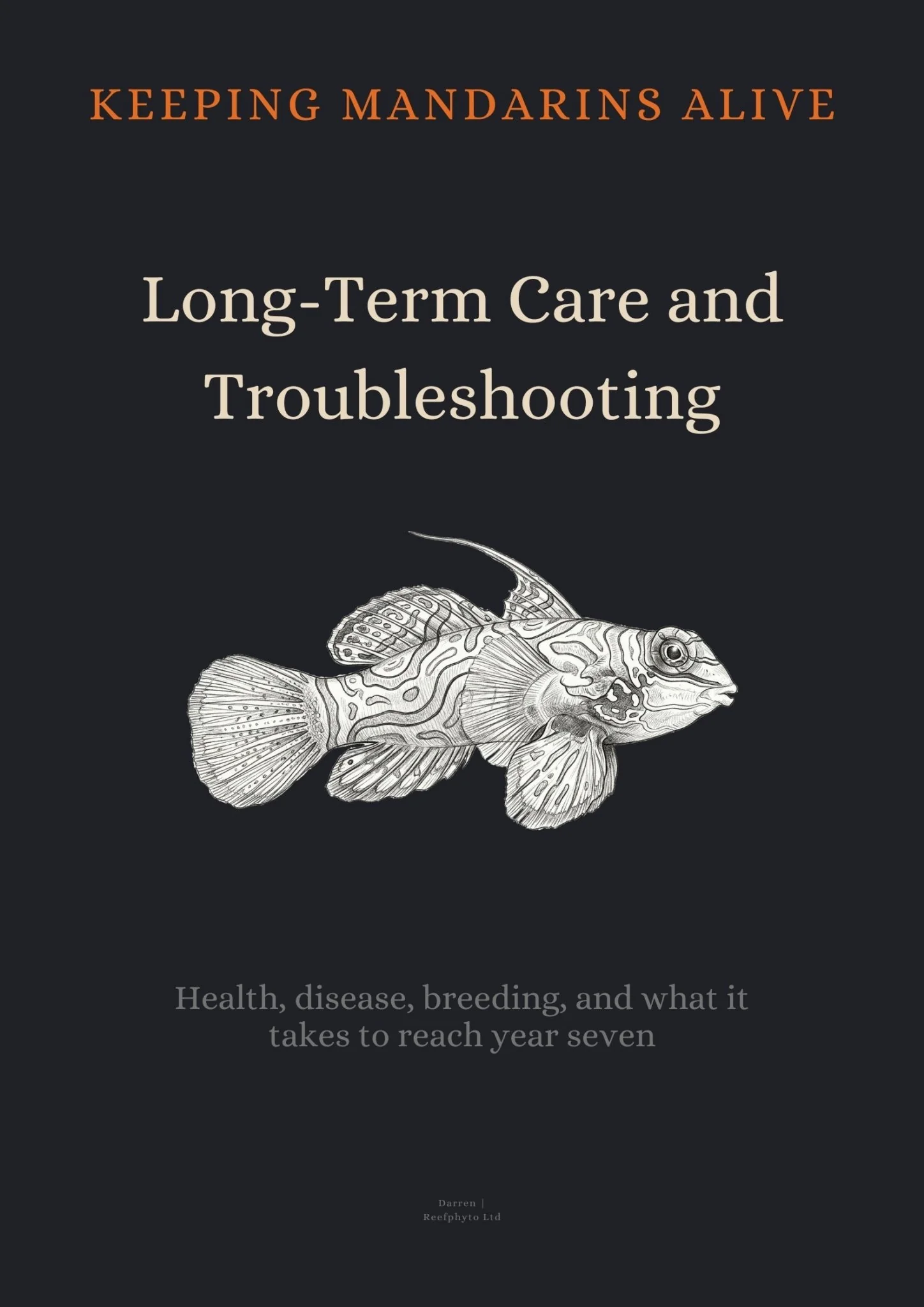
Keeping Mandarins Alive: Long-Term Care and Troubleshooting - Mandarin Health Guide
Keeping Mandarins Alive: Long-Term Care and Troubleshooting - Mandarin Health Guide
You have made it past the first year. The fish is settled, the feeding system is running, and the anxiety of the early months has given way to something that almost feels like confidence.
This is where most guides stop. It is also where the most preventable losses happen.
Long-term success with a mandarin requires the same quality of attention in year three that it needed in month one - not the same anxiety, but the same observation. Guide 3 gives you the knowledge and the habits to sustain it: disease recognition and response, the copper problem and its safe alternatives, long-term tank management, breeding, and an honest look at what separates a fish that lives two years from one that lives seven.
Written by Darren, Director of Reefphyto Ltd. 25 pages. Instant PDF download, delivered to your inbox immediately after purchase.
Long-Term Care and Troubleshooting
Most guides to mandarin goby care focus on the first few months - setup, sourcing, initial feeding. That information is valuable. But the keepers who lose mandarins in year two, three, or four are not failing at the basics. They are failing at the next level: disease recognition, medication decisions, the slow changes that happen in a maturing reef, and the habits that separate keepers whose fish reach year seven from those whose fish quietly decline and disappear.
This guide addresses that next level directly.
Disease Recognition and Response
The mandarin goby is susceptible to the same diseases as other reef fish, but its sensitivity to copper-based medications - the standard treatment for most marine parasites - means that standard protocols can kill the treatment subject as easily as the disease. Knowing how to identify what you are dealing with, and knowing which treatments are safe for mandarins specifically, is not optional knowledge. It is the difference between saving the fish and losing it to the cure.
This guide covers the five diseases most likely to affect mandarins in a home reef: Cryptocaryon irritans (white spot), Amyloodinium ocellatum (velvet), Brooklynella hostilis, bacterial infections, and internal parasites. For each condition: what it looks like, how fast it progresses, and what to do - including safe treatment protocols for copper-sensitive fish.
The Copper Problem
Copper-based medications are lethal to mandarins at therapeutic doses. This is not a fringe view - it is a well-documented pharmacological reality. Yet copper remains the default recommendation for marine ich and velvet in most hobbyist resources, and many keepers only discover the mandarin sensitivity at the worst possible moment.
This guide explains why copper is dangerous for mandarins specifically, lists the medications to avoid and why, and covers the alternatives that work: chloroquine phosphate, hyposalinity, formalin baths, and tank fallow. It also covers how to set up a quarantine tank for a mandarin - including the critical difference from a standard QT, which is the requirement to provide live food throughout any treatment period.
What the Guide Covers
Health assessment in depth - colouration changes, fin condition, eye clarity, breathing rate, skin surface assessment, and the daily five-minute observation habit that catches problems before they become crises.
Disease recognition and safe treatment - identification guides and safe treatment protocols for the five most common mandarin diseases, including a disease quick-reference table and a medication safety guide listing nine common medications with their safety status for mandarins.
Long-term tank management - how a maturing reef changes the picture for mandarin keeping, when and how to make changes safely, managing new fish additions, and an annual system review checklist.
Breeding - how to sex mandarins, what a bonded pair looks like, the spawning ascent described in full, and an honest assessment of whether raising larvae at home is realistic for most keepers.
What separates two years from seven - the five habits and one underlying mindset that characterise keepers whose mandarins live long lives, written plainly and without padding.
The Complete Series
Long-Term Care and Troubleshooting is the third guide in the Keeping Mandarins Alive series. Guide 1 - The Right Start - covers tank setup, compatibility, sourcing, and the critical first 30 days. Guide 2 - Feeding Mandarins That Refuse to Die - covers the complete live food system. All three guides are available individually or as a complete bundle at a saving of £6.
Product Information
Product Information
Shipping & Returns
Shipping & Returns
Description
Keeping Mandarins Alive: Long-Term Care and Troubleshooting - Mandarin Health Guide
You have made it past the first year. The fish is settled, the feeding system is running, and the anxiety of the early months has given way to something that almost feels like confidence.
This is where most guides stop. It is also where the most preventable losses happen.
Long-term success with a mandarin requires the same quality of attention in year three that it needed in month one - not the same anxiety, but the same observation. Guide 3 gives you the knowledge and the habits to sustain it: disease recognition and response, the copper problem and its safe alternatives, long-term tank management, breeding, and an honest look at what separates a fish that lives two years from one that lives seven.
Written by Darren, Director of Reefphyto Ltd. 25 pages. Instant PDF download, delivered to your inbox immediately after purchase.
Long-Term Care and Troubleshooting
Most guides to mandarin goby care focus on the first few months - setup, sourcing, initial feeding. That information is valuable. But the keepers who lose mandarins in year two, three, or four are not failing at the basics. They are failing at the next level: disease recognition, medication decisions, the slow changes that happen in a maturing reef, and the habits that separate keepers whose fish reach year seven from those whose fish quietly decline and disappear.
This guide addresses that next level directly.
Disease Recognition and Response
The mandarin goby is susceptible to the same diseases as other reef fish, but its sensitivity to copper-based medications - the standard treatment for most marine parasites - means that standard protocols can kill the treatment subject as easily as the disease. Knowing how to identify what you are dealing with, and knowing which treatments are safe for mandarins specifically, is not optional knowledge. It is the difference between saving the fish and losing it to the cure.
This guide covers the five diseases most likely to affect mandarins in a home reef: Cryptocaryon irritans (white spot), Amyloodinium ocellatum (velvet), Brooklynella hostilis, bacterial infections, and internal parasites. For each condition: what it looks like, how fast it progresses, and what to do - including safe treatment protocols for copper-sensitive fish.
The Copper Problem
Copper-based medications are lethal to mandarins at therapeutic doses. This is not a fringe view - it is a well-documented pharmacological reality. Yet copper remains the default recommendation for marine ich and velvet in most hobbyist resources, and many keepers only discover the mandarin sensitivity at the worst possible moment.
This guide explains why copper is dangerous for mandarins specifically, lists the medications to avoid and why, and covers the alternatives that work: chloroquine phosphate, hyposalinity, formalin baths, and tank fallow. It also covers how to set up a quarantine tank for a mandarin - including the critical difference from a standard QT, which is the requirement to provide live food throughout any treatment period.
What the Guide Covers
Health assessment in depth - colouration changes, fin condition, eye clarity, breathing rate, skin surface assessment, and the daily five-minute observation habit that catches problems before they become crises.
Disease recognition and safe treatment - identification guides and safe treatment protocols for the five most common mandarin diseases, including a disease quick-reference table and a medication safety guide listing nine common medications with their safety status for mandarins.
Long-term tank management - how a maturing reef changes the picture for mandarin keeping, when and how to make changes safely, managing new fish additions, and an annual system review checklist.
Breeding - how to sex mandarins, what a bonded pair looks like, the spawning ascent described in full, and an honest assessment of whether raising larvae at home is realistic for most keepers.
What separates two years from seven - the five habits and one underlying mindset that characterise keepers whose mandarins live long lives, written plainly and without padding.
The Complete Series
Long-Term Care and Troubleshooting is the third guide in the Keeping Mandarins Alive series. Guide 1 - The Right Start - covers tank setup, compatibility, sourcing, and the critical first 30 days. Guide 2 - Feeding Mandarins That Refuse to Die - covers the complete live food system. All three guides are available individually or as a complete bundle at a saving of £6.